Last edited: May 1, 2026.
French visas and entry requirements for studying in France depend on your nationality and the length of your stay. Getting this right from the start is important. This section gives you a clear overview of your options.
Important: Visa rules can change. Always verify the latest requirements on the official French government visa website: france-visas.gouv.fr. Your local French embassy or consulate is also a reliable source.
EU vs. Non-EU Students
Your nationality determines whether you need a visa at all, and if you do, which type applies.
| Student Profile | Entry Requirements |
| EU / EEA / Swiss Nationals | No visa required for any length of stay. You can study in France freely with your national ID card or passport. No additional paperwork is needed before you arrive. |
| Non-EU Nationals (short-stay under 90 days) | Most nationalities do not need a visa for stays up to 90 days within any 180-day period (Schengen rules). However, some nationalities do require a short-stay visa. |
| Non-EU nationals (long-stay over 90 days) | A long-stay visa is required before you travel. The two main options for students are the Student Visa (VLS-TS) and the Working Holiday Visa (VVT) — covered in detail below. |
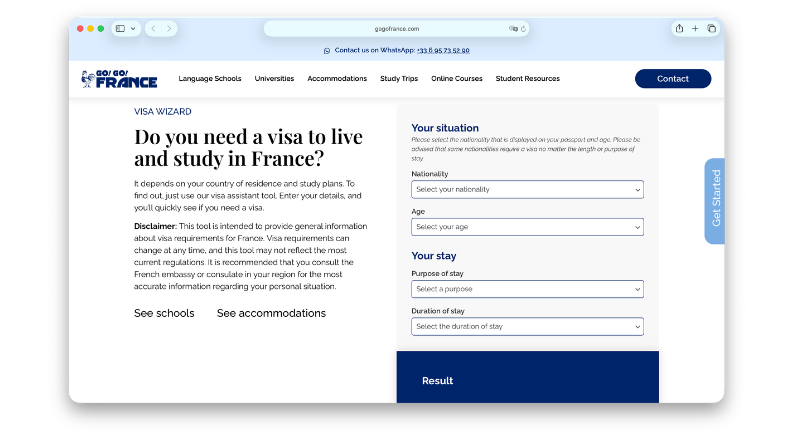
| Useful tool: Not sure if you need a visa to study in France, or how long you can remain in the Schengen Area without overstaying? Our visa calculators give you an instant answer based on your nationality and the length of your course. |
Short Stay Visa (Under 90 Days)
Depending on your nationality, you may need a Schengen short-stay visa for stays under 90 days.
Citizens of many countries, including the USA, Canada, Australia, South Korea, and Japan, currently do not need a visa for short stays. While UK citizens are still visa-exempt for short stays in France, this may be subject to change in the future.
Required Documents
For a Schengen short-stay visa, you will be asked to show the following documents:
- Passport ID page
- ALL pages of your passport containing visas, entry and exit stamps
- ID photograph
- Enrollment certificate or acceptance letter from your school in France
- Rental agreement or other proof of accommodation in France
- Recent bank statement
- Health insurance certificate
- Return ticket or affidavit to leave France
Financial Requirements
You need to show proof of income of €65 per day with a hotel booking, or €120 per day without one. You must also provide travel insurance with medical coverage of at least €30,000.
Student Visa (6 months to 1 year)
If you plan to study in France for 6 months or more, you will need a student visa.
This visa allows you to live, study, and work in France for 6 months to 1 year, and can be extended if you continue your studies. It is the best visa option for those planning to live and study in France long-term.
Student Visa Benefits
- Work part-time up to 964 hours per year (approximately 20 hours per week)
- Travel freely within the Schengen Area
- Free access to French health insurance (Sécurité Sociale)
- Receive housing aid (APL) only if you are a scholarship student
- Access to VISALE, the French government-backed guarantor service for student rentals
- Extend your stay if you continue your studies
Application Process
The application process varies slightly depending on your country, but the main steps are:
| 1. Get accepted by an accredited French institution. You need an acceptance letter or enrollment certificate before you can apply for a visa. This document is issued by your school in France after you pay your tuition fees or a deposit. |
| 2. Complete the Études en France procedure (if your country requires it). Students from 70+ countries — including the USA, Japan, South Korea, and many others — must register through the Études en France platform before applying. |
| 3. Fill out your visa application online at France-Visas and upload your supporting documents. |
| 4. Book and attend your visa appointment. Bring your printed application and all required documents. An agent will collect your biometric data (photo, fingerprints). |
| 5. Validate your visa upon arrival in France. Once you arrive, you must validate your visa online through the OFII portal. This is mandatory and makes your visa valid as a residence permit. |
Watch this video to get an overview of the process:
Required Documents
You will need the following documents for your student visa application:
- Visa application form and receipt
- Études en France certificate
- Passport ID page
- ALL pages of your passport containing visas, entry and exit stamps
- ID photograph
- Enrollment certificate or acceptance letter from your school in France
- Rental agreement or other proof of accommodation in France
- Recent bank statement
Financial Requirements
You must show a minimum monthly income of €877.50. If you plan to study in France for 1 year, you should submit a bank statement showing a minimum balance of €10,530.
| Did you know? Starting August 1st 2026, France is changing the financial requirement for student visas. Until now, you had to prove you had at least €615 per month. Now, that amount has increased to €877.50 per month. But here’s the biggest change: It’s no longer a fixed amount. This new amount is set at 47% of the French minimum wage (SMIC) and will change automatically as the SMIC increases with inflation. |
Application Timing
Students who need a visa to study in France should begin the application process about 4 to 6 months before the course start date.
This allows enough time to apply to your chosen school, receive an acceptance letter, secure accommodation, and complete the visa process smoothly. Starting early also ensures you have time to prepare financial documents, schedule and attend your visa appointment, and receive your visa before your planned departure.
Working Holiday Visa (1 year)
The Working Holiday Visa is a great option for young students who want to combine study, work and travel. This visa allows you to study in France while giving you the flexibility to travel where you want in France and within the Schengen area*, and work with no employer restrictions and no hour limits.
This visa is issued once, is valid for 1 year and can’t be renewed, except for Canadian nationals. It has an age limit, operates on a quota basis, and is only available to a limited number of countries that have a bilateral agreement with France.
*Note: Unlike student visa holders, who are not limited, working holiday visa holders can travel within the Schengen Area for up to 90 days in any 180-day period, in line with standard Schengen rules.
Eligible Nationalities (as of 2026)
| Americas | Asia-Pacific | Age Limit Notes |
| Argentina Brazil Canada Chile Colombia Ecuador Mexico Peru Uruguay | Australia Hong Kong Japan New Zealand Russia South Korea Taiwan | – Up to 30 for Chile, Ecuador, Hong Kong, Mexico, and Peru – Up to 31 for Brazil, Colombia, South Korea, Japan, New Zealand, Russia, Taiwan, and Uruguay – Up to 36 for Argentina, Australia, and Canada |
Working Holiday Visa Benefits
- Full-time work permitted with no employer restrictions and no hour limits
- Travel freely within the Schengen Area
Required Documents
You will need the following documents for your working holiday visa application:
- Passport ID page
- ALL pages of your passport containing visas, entry and exit stamps
- ID photograph
- Recent bank statement
- Health insurance certificate
- Return ticket or affidavit to leave France
- Proof of a clean criminal record
- Motivation letter
Financial Requirements
The exact amount depends on the agreement between France and your country, but it is usually between €2,500 and €4,000. For example, Japanese students need to show €3,100 (not including round-trip airfare), and Korean students must have at least €2,500, or €3,500 if they submit a one-way airline ticket.
FAQ French Visas
1. Who is exempt from a Short-Stay Visa for France?
Citizens of the European Union (EU), European Economic Area (EEA), and Switzerland are exempt, as well as citizens from certain other countries. Use our Visa Calculator to find out if you’re exempt or need a visa and how to apply based on your situation.
2. Are there age restrictions for visa applications in France?
Yes. To apply for a student visa, you must be over 18. For a working holiday visa, the age range is 18 to 30 years old.
3. Who can apply for a Student Visa in France?
To apply for a Student Visa, you must be at least 18 years old and accepted into a higher education institution in France. This visa is intended for students planning to live and study in France for more than 3 months.
4. Who can apply for a Working Holiday Visa in France?
You can apply for a Working Holiday Visa if you are between 18 and 30 years old and hold a passport from one of the following countries: Australia, Argentina, Brazil, Canada, Chile, Colombia, Ecuador, South Korea, Japan, New Zealand, Hong Kong, Mexico, Peru, Russia, Taiwan, Uruguay.
5. Where do I apply for a visa to study in France?
You must apply through the French embassy or consulate in your country of residence. In some cases, applications are handled by approved external service providers. Find your place of submission.
6. What is the best visa to move to France?
If you want to live and study in France for a long time, the student visa is usually the best choice.
7. What visa options do you help with?
We can help you apply for a student visa, a working holiday visa, or a short-stay visa if you need one.
French Visas Comparison Table
Here is a side-by-side overview of what each visa type offers, so you can find the best fit for your situation at a glance.
| EU / EEA / Swiss Nationals | Short Stay Visa | Student Visa | Working Holiday Visa | |
| Access to Schengen area | Yes | Yes | Yes | Yes |
| Study in France | Yes | Yes | Yes | Yes |
| Work in France | Yes | No | Yes | Yes |
| French health insurance | Yes | No | Yes | No |
| Access to housing aid | Yes | No | Under conditions | No |
| Access to VISALE | Yes | No | Yes | No |
| Visa renewable | N/A | No | Yes | No |
Need help with your visa? The Go! Go! France team guides students through the visa process — from identifying the right visa type to preparing your documents. Get in touch for free advice.