
One of the first practical steps after arriving in France is getting a French phone number.
This guide explains how the French mobile system works, the differences between prepaid and postpaid plans, and which option is best depending on your stage of arrival and long-term plans.
Key Takeaways
- A French phone number is often required for housing searches, banking, government services, and everyday administration.
- Prepaid SIM cards are the fastest way to get connected and typically require only a passport or ID.
- Postpaid plans generally offer better value and are the preferred option for students, expats, and long-term residents.
- France offers two types of postpaid plans: commitment plans (12–24 months) and no-commitment plans that can be cancelled at any time.
- No-commitment providers such as Sosh, RED by SFR, B&You, and Free Mobile are often the best option for newcomers.
- A French bank account may be required to subscribe, particularly for traditional commitment-based contracts.

What is the difference between postpaid and prepaid phone plans in France?
Postpaid plans offer long-term stability and better pricing, while prepaid SIMs are temporary, flexible, and ideal for arrival.
In France, mobile services are generally divided into:
| Postpaid (Forfait mobile) | Prepaid (Carte SIM prépayée) |
| – Monthly subscription billed after usage – Better value for data and calls – Often required for long-term administrative life – May require a French bank account – Includes commitment or no-commitment options | – Pay upfront for credit or short-term bundles – No contract or bank account required – More expensive per GB – Designed for tourists or initial arrival phase |
For long-term cultural immersion, postpaid is usually the natural transition once you are settled.
What are prepaid SIM cards in France and when should you use them?
Prepaid SIM cards are short-term mobile solutions that require no contract or bank account and are best used only upon arrival.
They are useful for:
- First 1–2 weeks in France
- Backup connectivity if needed
- Travelers or students without immediate address proof
They often come in two formats: physical SIM cards and eSIM cards. A physical SIM card is inserted directly into your phone, while an eSIM is activated digitally by scanning a QR code. Both require your phone to be SIM-unlocked, otherwise, you must request an unlock from your current provider (this is often free but can take a few days).
You can buy them directly at Orange, SFR, or Bouygues Telecom stores, as well as in supermarkets, airports, and even tobacco stores in France.
Where can you purchase an eSIM card for France?
Go! Go! France has partnered with Holafly to offer eSIM cards with unlimited data (4G/LTE/5G) for students and tourists during their stay in France.
To purchase your eSIM, visit the Holafly eSIM page for France and get a 5% discount.
For more information about the features and technical specs, visit the Holafly website or contact our partner directly.
What are the two types of postpaid plans in France?
France offers both commitment-based and no-commitment postpaid plans, with the same operators often providing both under different brands.
What are commitment plans (with contract) in France?
Commitment plans are traditional mobile contracts where you agree to stay for 12 to 24 months in exchange for subsidized pricing or device offers.
These plans are more common among long-term residents who want bundled services or device financing. They are typically offered by major operators such as:
Key characteristics:
- 12–24 month commitment period
- Often includes phone discounts or bundle deals
- Requires stronger administrative setup (proof of address, sometimes bank details)
- More “traditional” French telecom structure
What are no-commitment postpaid plans in France?
No-commitment plans offer full monthly subscriptions without locking you into a contract, making them ideal for international students and newcomers.
These are extremely popular in France and often the best starting point for long-term language learners. These plans are widely used by students, expats, and long-term visitors. Each major operator has a low-cost branch:
- Orange → Sosh
- SFR → RED by SFR
- Bouygues Telecom → B&You
- Free Mobile
Key characteristics:
- No 12–24 month commitment
- Easy online signup
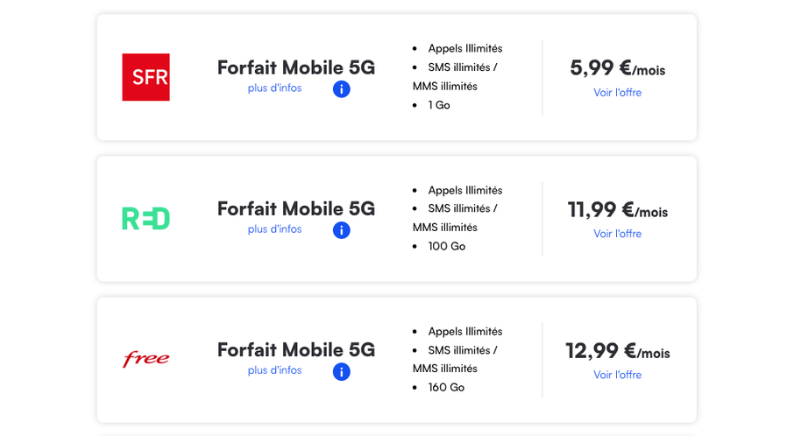
- Lower monthly cost (often €5–€20 range depending on data)
- Easier cancellation or switching
- Minimal paperwork compared to traditional contracts
Which option should you choose as a new arrival?
No-commitment postpaid plans (Sosh, RED by SFR, B&You, Free Mobile) are usually the best first stable option after arrival.
This is especially true during the early “settling phase”, when key administrative steps such as moving into your accommodation, opening a French bank account, validating your student visa, registering for healthcare services through Sécurité sociale, and applying for student aid via CAF or student services via CROUS are still in progress.
| Comparison Tool: UFC-Que Choisir is an independent comparison tool: Compare mobile plans |
Do you need a French bank account for postpaid plans?
You usually need a French bank account for most postpaid subscriptions, but this is not always required for no-commitment online plans.
In practice:
- Commitment plans → almost always require a French bank account (IBAN/RIB) and proof of address
- No-commitment plans → often require only an ID and a payment card (depending on the operator)
Read more on how to open a bank account in France
Summary: Which mobile option should you choose in France?
The best mobile option in France depends on how long you are staying and how settled you already are in your administrative life.
Here is a simple comparison to help you choose quickly:
| Summary | Prepaid physical SIM or eSIM card | No-commitment postpaid plans | Commitment postpaid |
|---|---|---|---|
| Where | Online, supermarkets, airports, tobacco stores | Sosh, RED, B&You, Free Mobile | Orange, SFR, Bouygues Telecom |
| Best for | Arrival, first days and weeks in France | Students and long-term residents | Long-term residents |
| Contract | No | No | Yes, usually 12–24 months commitment |
| Required documents | Passport | ID, bank card | French bank account, proof of address |
| Pros | Instant setup, no bank account needed | Cheap, flexible, easy to cancel | Best stability, device offers and other deals, full support |
| Cons | More expensive, limited long-term value | Limited customer support | Less flexible, harder to cancel |
Want to go further? Visit our blog for more practical guides on studying and living in France.