
Between school enrollment, accommodation, flights, and visa procedures, you’ve already cleared the biggest hurdles of your move to France. What’s left are the smaller, easy-to-overlook tasks that can still cause a headache if they slip through the cracks in your final weeks before departure.
This departure checklist covers exactly those tasks. Go through it item by item, and you’ll arrive in France with your tuition settled, your visa understood, your health coverage active, and your documents backed up, so you can spend your first days actually enjoying the country instead of scrambling to catch up on paperwork.

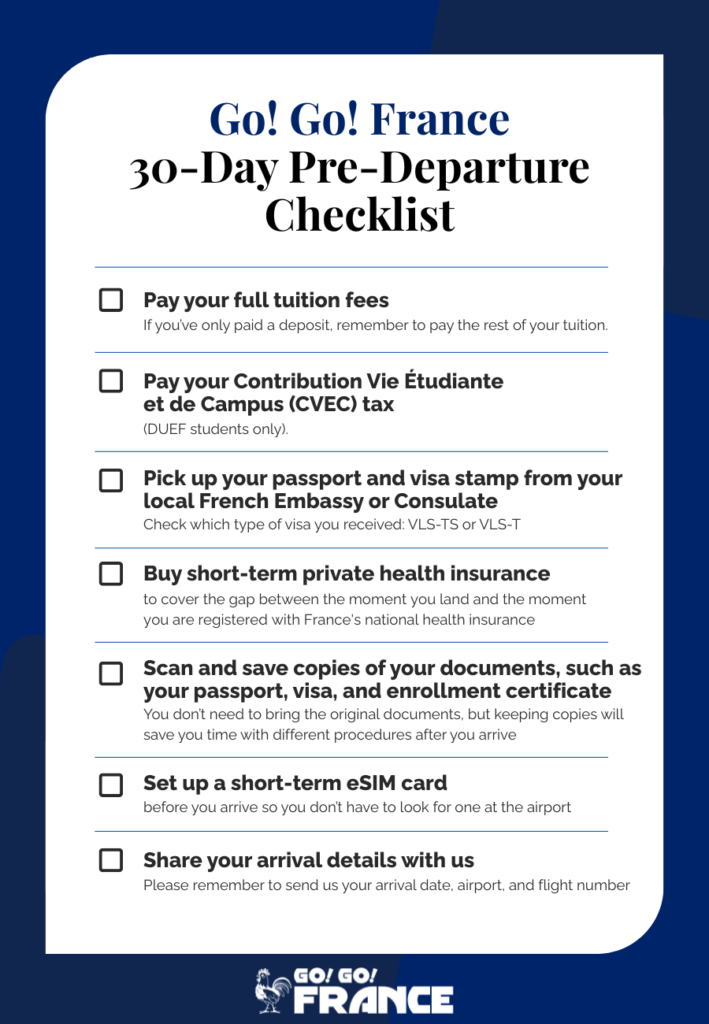
Departure checklist
◻︎ Pay your tuition fees
Make sure you have paid your full tuition, not just the deposit. Sometimes students pay only the deposit before getting their visa and plan to pay the rest later, but then forget. You need to pay the full amount before classes start, or your school might hold your class schedule and not let you in on the first day if your payment is incomplete.
◻︎ Pay your CVEC before arrival, if you’re in a DUEF program
Students enrolled in a DUEF program managed by a French university need to pay the Contribution Vie Étudiante et de Campus (CVEC) before arriving in France.
For more information, check out our article: What is the CVEC and do you need to pay it?
◻︎ Collect your student visa and confirm exactly which one you were granted
Look at the visa sticker in your passport and see what it says:
- A VLS-TS (Visa de Long Séjour valant Titre de Séjour) is a long-stay visa valid as a residence permit, which typically allows part-time work, gives you access to national health insurance, and can be extended beyond its initial validity. If you were issued a VLS-TS, you must validate it within three months of arriving in France.
- A VLS-T (Visa de Long Séjour Temporaire) is a temporary long-stay visa that does not require validation, but it also does not carry the same benefits as the VLS-TS.
◻︎ Buy short-term private health insurance to cover your first months in France
You need proof of coverage from the moment you land. Long-term students staying more than three months are eligible to register with France’s national health insurance, but that registration takes several weeks to process, so private insurance is necessary to cover the gap in the meantime.
If you are not sure where to find insurance, we suggest checking out our partner’s offer. WorldTrips insurance package covers both medical and travel expenses, so you are also protected if your luggage is lost or stolen. For more details about the insurance premium and coverage, you can read their brochure or email them at info@envisageglobalinsurance.com.
To sign up, visit: https://gogofrance.com/en/health-insurance-for-students-in-france/
◻︎ Get a short-term eSIM to cover your first days and weeks in France
You’ll need an internet connection as soon as you arrive. Setting up an eSIM in advance means that the moment your plane lands, you can turn on your roaming data and immediately have internet access to let your loved ones know you’ve arrived safely.
Having a connection at the airport also makes it much easier to translate signs, find directions, and book a taxi to your new home.
Go! Go! France has partnered with Holafly to offer students a 5% discount on eSIM cards for France with unlimited data (4G/LTE/5G) during their stay. You can purchase your eSIM on the eSIM for France page.
◻︎ Confirm your credit card works in France
You likely won’t have time to open a French bank account in your first days after arrival, and there are also prerequisites you’ll need to meet before you can do so. France is largely cashless, so it’s important to confirm your card works there before you leave, rather than relying on cash in your first few days.
If your card does not work in France, Go! Go! France partners with Wise to offer a multi-currency account. With Wise, you can keep euros and use a debit card to pay for purchases in France. You can also transfer money from your home currency to euros for rent, tuition, or daily expenses.
Apply for a Wise account online
◻︎ Contact your Go! Go! France Student Advisor to confirm your arrival details
Share your arrival date, arrival airport, and flight number with your Student Advisor. This information will be communicated to your school ahead of your arrival.
◻︎ Scan every key document
Make copies of your passport, visa, enrollment certificate, insurance policy, birth certificate, diplomas, and any other important documents you may need in France.
You don’t need to bring the originals, but having copies stored on your phone or in a personal cloud folder will save you time on multiple procedures after arrival, including:
- Validating your VLS-TS visa
- Applying for national health insurance
- Opening a French bank account
- Getting a French phone number
◻︎ Pack and prepare what you’ll need to settle in smoothly
Deciding what to bring can be tough. Check the Go! Go! France packing guide for a full list of recommended items.
Save and print out departure checklist
With this list checked off, the hardest part is behind you. All that’s left now is the flight, and the France you’ve been dreaming about for years.
Looking for more guidance on settling in? Visit the Go! Go! France blog for more articles on visas, housing, banking, and daily life in France.