Thinking about moving to France for your studies, and not sure when to start applying?
Here’s a simple step-by-step guide to the application timeline and all the key things you’ll want to get done.
How far in advance should I apply to study in France?
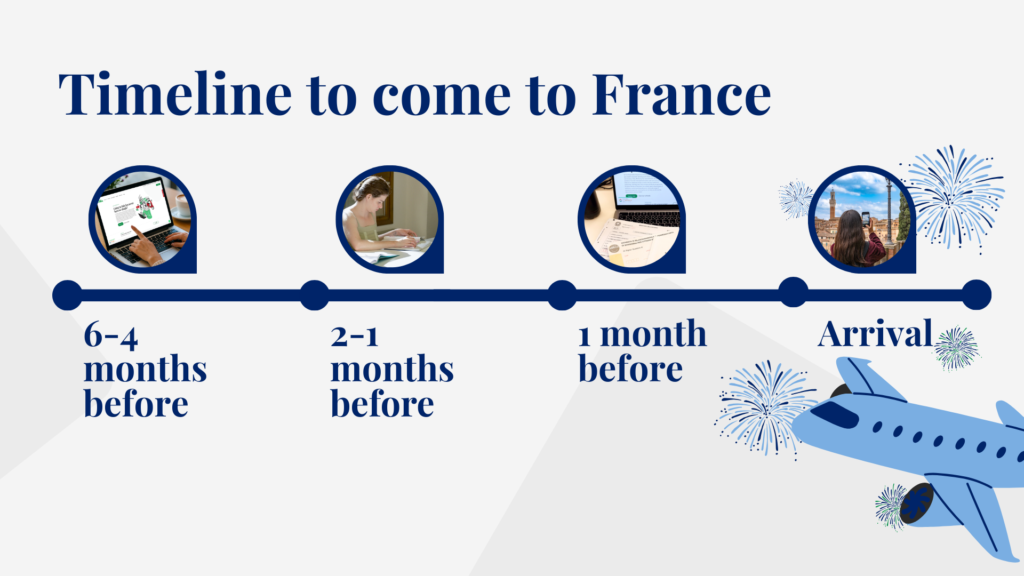
Start your application about 4 to 6 months before you plan to arrive in France. This gives you enough time to complete school paperwork and meet visa requirements based on your nationality and the length of your course.
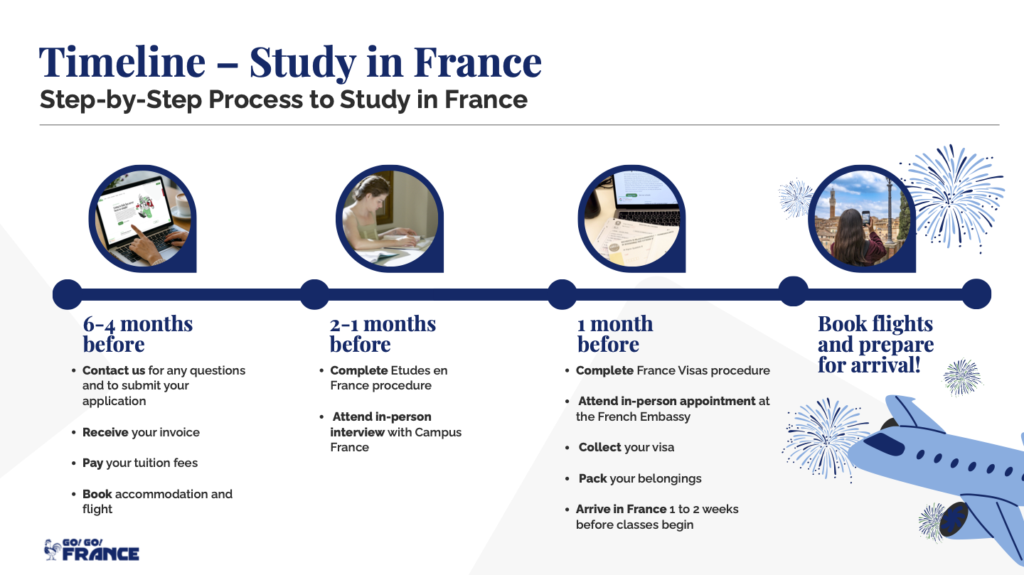
6-4 months before
Contact us
Contact us and share your goals for studying in France. If you have any questions or concerns, let us know. We’ll help you choose the right school and guide you through every step of the application process.
Submit your application
Submit your application and documents, then wait for our update. The school will review your application and send you a tuition invoice.
Pay your tuition fees via bank transfer
Most schools allow you to pay a deposit first if you need a student visa, and you can pay the remaining amount after your visa is approved. You must have paid all fees before classes begin.
Receive your acceptance letter
After your payment or deposit is processed, you will receive your acceptance letter. You will need this letter for your visa application.
Find and book accommodation
As soon as you receive your acceptance letter, you can start looking for accommodation. Thanks to our partners, there is no need for income proof, no complicated paperwork, no guarantors, and no in-person viewings required. You will receive an official accommodation certificate to use for your visa application.
Book your flight
The timing of when to buy your ticket is entirely up to you. Some students prefer to book their flight ticket as early as possible to get the best price, while others prefer to wait until their visa is issued.
Best practices:
- Choose a landing date on a weekday between 8:00 and 18:00. Avoid national holidays or weekends, as arriving on these days may delay your move and prevent you from running errands because shops may be closed.
- Try to arrive 1 to 2 weeks before classes start. Booking a flight too early can be risky if your visa isn’t ready, so it’s best to book closer to your class start date.
- Think about getting trip cancellation insurance when booking your flight, in case you need to change your travel plans.
2-1 months before
Submit your application on Etudes-en-France
Students from more than 70 countries are affected by this procedure and must go through it before applying for their student visa.
Read our Etudes en France guidelines for more information.
Attend your in-person interview with Campus France
A Campus France agent will check your application, verify your documents, and ask questions about your background and plans in France. The interview helps assess your educational and professional background and how it aligns with your academic goals in France. There is no preparation needed, but be ready to discuss your motivations, your study plans, and what you hope to achieve in France.
1 month before
Submit your visa application on France-Visas
Submit your visa application online, upload your supporting documents, and attend an in-person appointment at the French Embassy, Consulate, or visa center in your area.
You can check our France-Visas step-by-step guide for more details.
Collect your visa
You will get a notification when your visa is ready to pick up at the visa center where you applied. Most visas are processed within 15 days.
Pack your belongings and take your flight!
We’ve put together this handy list of what to pack for France. Some are essentials and some are to help with those pangs of home sickness you might feel from time to time.

Arrival
Move into your new accommodation
We recommend choosing a landing date on a weekday between 8:00 and 18:00. Avoid national holidays or weekends, as arriving on these days may delay your move and prevent you from running errands because shops may be closed.
Start school
Don’t stress about your first day of school. The staff will welcome you and show you around the facilities and your classroom. You’ll receive your schedule and guidelines from the school about 1 to 2 weeks before classes start.
Validate your visa
You must validate your visa at the French Office for Immigration and Integration (OFII) within 3 months of arriving. This is a required step, and if you don’t complete it, you won’t be able to stay in France legally. You can do everything online at home, and our team will send you all the instructions on time.
Register with the French national insurance
All students in France need health insurance. Registration is free and mandatory, and once enrolled, 70% of your health costs are covered. We suggest getting extra health insurance, called mutuelle, to cover the rest.
Check out our detailed French healthcare guide for more information.
Apply for housing allowance
Starting in July 2026, only students from the EU, EEA, Switzerland, or those who have a scholarship will be able to get housing allowance from the French government.
If you qualify, you can apply for housing allowance through Caisses d’Allocations Familiales (CAF). The amount you receive depends on your income, the size of your accommodation, and its location. Most students get between €100 and €300 per month, but the exact amount will vary based on your situation.
You can check your eligibility and get an estimate here: CAF Housing Allowance
Open a French bank account
You can open an account at a traditional French bank, though many have monthly fees. Major banks include BNP Paribas, Crédit Agricole, Banque Populaire, Caisse d’Épargne, Crédit Mutuel-CIC, Société Générale, and La Banque Postale.
We suggest opening a bank account with Wise. By signing up, you get a French IBAN and can hold euros and other currencies in one account. The Wise debit card works for daily purchases in France, and you can easily transfer money from your home currency to euros for rent, tuition, or living expenses.
Apply here: Wise Account
Get a French phone number
Mobile phone plans in France are usually affordable, with basic or student options starting at around €10 per month.
There are four main mobile operators in France: Orange, SFR, Bouygues Telecom, and Free Mobile. Each offers plans with or without commitment, and often the no-commitment plans are sold under different brand names.
| With commitment | Without commitment |
| Orange | Sosh |
| SFR | Red |
| Bouygues Telecom | B&You |
| Free Mobile |
How can I apply to study in France with Go! Go! France?
We offer our support for free, so you pay the exact same fees to the language school or university as you would if you applied on your own. So why wouldn’t you want to make it easier for yourself?
To apply, contact us directly. Our team will guide you through the school selection, application paperwork, and visa process.