
France is known for its high-quality healthcare system, which many people say is one of the best and even free. But is healthcare in France really free? In short, yes, it is free at the point of entry.
If you are planning to move to France as a student, this article will explain what “free at the point of entry” means and what healthcare in France actually costs.
The foundations and philosophy of the French healthcare system
The French healthcare system was created after World War II. In 1945, as France was rebuilding, the government established a social security system, Sécurité Sociale, to protect citizens from major risks such as illness. The goal was to ensure everyone, regardless of income or background, could receive the same high-quality medical care. This idea of universal coverage and solidarity is the foundation of the French healthcare system.
How does the French healthcare system work?
The French healthcare system is mainly funded by social contributions and taxes.
Contributions from employees, employers, and self-employed workers account for about half of the funds collected for healthcare (48–50%). There is also a special tax called the contribution sociale généralisée (CSG), which funds about 20%. Other taxes on things like tobacco, alcohol, and private insurance add about 15%. The government then provides the rest with public funds.
Each year, the government decides on these resources in the Social Security Financing Act.
What does “free at the point of entry” mean?
When people say healthcare in France is free at the point of entry, they mean that the most important healthcare services are available to everyone without having to pay upfront.
Patients can see doctors, go to hospitals, and visit clinics without worrying about high costs. All or nearly all of the medical costs are already covered by the healthcare system. This is possible because of the social contributions and taxes collected by the government, as explained above.
The part of healthcare costs not covered by the system is usually covered by private insurance. By law, all private-sector employers must offer a health insurance package to their employees. Most employers pay at least half of the premium, and the remaining amount is deducted from the employee’s gross salary. Students, retirees, and those who are self-employed must arrange their own private health insurance.
Do patients have to pay anything out of pocket?
Yes, patients may sometimes have to pay a small fee or cover the cost of premium services not fully reimbursed by the healthcare system or private insurance.
For example, while standard glasses are typically covered, extras like anti-reflective coatings or designer frames may result in out-of-pocket costs.
What about a visit to the doctor? When you want to see a doctor in France, 70% of the cost is covered by the healthcare system after deduction of a 2€ flat-rate fee. This flat-rate fee was introduced in recent years to help fund the healthcare system. The other 30% is paid by your private health insurance, often called mutuelle in French.
- If you need to visit a generalist in France, the consultation costs 30€. The French healthcare system covers 19€ (30€ x 70% = 21€ – 2€ flat-fee = 19€), and your private health insurance usually pays the rest.
- If you need to visit a gynecologist, the consultation costs 35€. 22,50€ is already covered by the French healthcare system (35€ x 70% = 24.50€ – 2€ flat-fee = 22.50€), so you only have 12.50€ left that are most likely to be fully covered by your private health insurance.
Can foreigners or students use French healthcare?
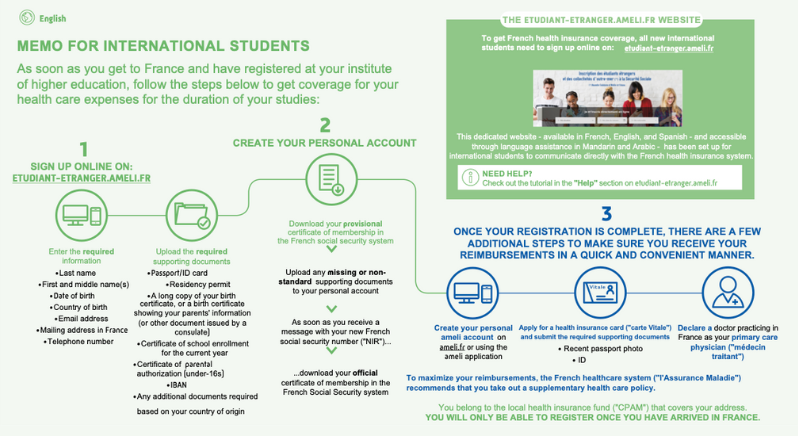
Yes, students who live and study in France with a student visa can access the healthcare system for free. Registration is free and required for all students in France.
You can register only after you arrive in France, and the process can take up to 1 month. That’s why we recommend our students get temporary travel and health insurance for at least their first month in France. This way, you are covered from when you leave your country until you are enrolled in the French healthcare system.
After you enroll, you get a green card called the Carte Vitale. You show this card when you visit doctors, hospitals, or clinics, so you don’t have to pay first and wait for a refund. With this card, the healthcare system pays the 70% directly to the doctor. Your private insurance works the same way. You get a card, and by showing it, your insurance pays your 30% share directly.
See the steps to get coverage for your health expenses in France:
Where to get private health insurance?
While there are many options, a popular choice for students is La Mutuelle des Étudiants (LMDE). It is the 1st private insurance provider in France to offer preventive services and health coverage to students.
Here is an independent comparison tool: UFC-Que Choisir – Health Insurance
If you are a student or planning to move to France and have questions about the healthcare system, you can contact our team. For more tips and guides on healthcare in France, check out our Go! Go! France blog.